Apis mellifera
Honey Bee (Introduced)
*Honey bees are NOT NATIVE to North America, and originate in Europe.
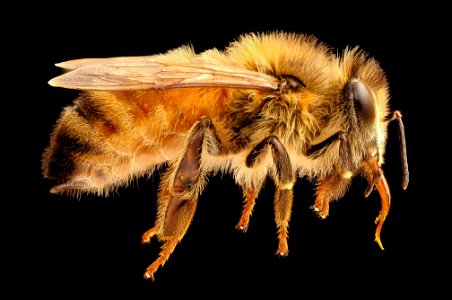
Honey bees are some of the most recognizable insects on the planet, and have become heavily associated with the task of pollinating agricultural crops. About one third of the human diet in North America is composed of insect pollinated crops, of which Honey bees account for 80% of this pollination. While there is no doubt that these insects are a crucial component of our economy, and that our lifestyle depends on them, it also raises the question: Are honey bees invasive? While honey bees are not aggressive or territorial in the sense that other invasive species may be, overtaking habitats and displacing local wildlife, there are a few things to note on their coexistence with native bees. The first being the competition for resources with native bees. Both honey bees and native bees share many of the same food sources, except honey bees are cared for by beekeepers and purposefully raised and transported to different areas to aid in pollinating crops or for honey production. What many people don’t realize is that this vast number of domesticated honey bees, which are essentially livestock, also target the food sources of native bees. Paired with the decline of native bee habitats, the presence of honey bees has become a factor contributing to native bee decline. However, we cannot simply eliminate the use of domestic bees given the scale of modern agriculture. One solution would be to create wildlife refuges for native bees, to ensure they have untouched sources of food far away from imported bee populations. Another would be to begin using native pollinators instead of honeybees for our agricultural fields. The problem with this second option is that native bees are solitary, meaning they do not from hives and instead live alone as single individuals. This results in far fewer bees in an area and also makes it difficult to breed large numbers of them. Relying on native pollinators to pollinate fields is a practice that became outdated the moment large scale crops came into existence. While native pollinators are effective at pollinating local flower species, they cannot meet the industrial demand of today’s large scale farming the same way honey bees can. The second issue with domestic bees is that they can harbor pests and diseases, which spread to native bees and further contribute to the decline of the native bee population. As of yet, there are no perfect solutions for the coexistence of native and domestic bees. One way to help is to plant a wide variety of native plants to provide native bees with food sources and shelter. While having a honey bee hive in the backyard might sound like a good idea, and a way to ‘save the bees’, honey bees are far from endangered, and are not the bees with which we should be concerned. Instead, target the favourite flower sources of bees native to your area, and plant a small refuge for them in your yard if you would like to do your part.